
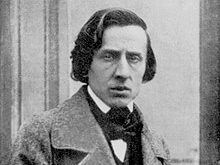
Fryderyk Franciszek Chopin was born on 1st March 1810 in Warsaw and was to become one of the world’s best known composers and virtuoso pianists. He has maintained worldwide renown as a composer whose “poetic genius was based on a professional technique that was without equal in his generation.” (Rosen, 1995).
Chopin Playlist – my recordings
These are my own recordings of a few of Chopin’s most popular works.
Table of Contents:
- Waltz Op. 69, No. 2
- Chopin’s Etude, Opus 10, No.3
- Chopin’s Preludes
- Chopin, Field and the Nocturne
- Chopin’s Legacy
After clicking the link to read each section, you can return to the Table of contents using the back button on your browser
Waltz Op. 69, No. 2
Chopin was a musical prodigy and he had completed many glorious early works by the time he was 20 years old. This first section focuses on an extremely popular waltz composed by Chopin in the year 1829 at the age of 19. Waltz Op. 69, No. 2. from Deux Valses (“Two Waltzes”) was only published posthumously in 1852. The main theme is in the key of B Minor and is marked with an overall tempo of Moderato.
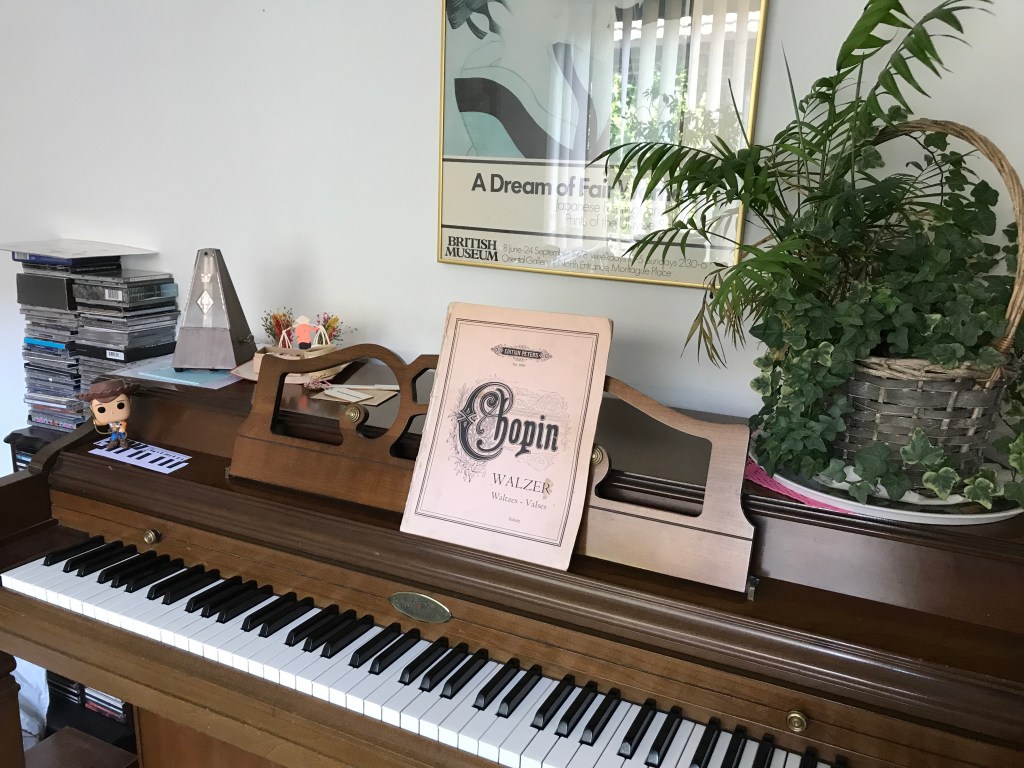
Chopin’s music has had a broad appeal and many of his melodies are instantly recognisable today. When I was a young psychology student at Glasgow University in the early 1970’s a lovely friend, Anne, gave me a book of Chopin Waltzes.

I have always felt daunted by the prospect of playing Chopin but my love of and respect for his music has led me to “try” one or two of his pieces and, now that I am retired, I have even managed to record my efforts.
The piece for me conveys a strong sense of underlying melancholia. There are three different sections. The waltz opens with a beautiful melody that is very popular. For right or wrong, I like to play the opening a bit slower than a lot of players because I genuinely feel that the slightly slower tempo conveys more of the underlying pathos of the piece. Soon the melody changes. It is quicker, lighter, smoother as if the load is lifted a little and is a little bit cheerier in tone. The change to a major key assists this. Then the melancholia returns with the opening theme reestablished toward the end. I suspect my fondness for this piece is due to the way the music seems to mirror perfectly the switches in mood Chopin is purported to have experienced throughout his life. Although it has achieved great popularity, ironically, it is one of several works that the composer hoped would be burnt upon his death. Thankfully, it wasn’t!
Chopin’s Etude, Opus 10, No.3
Étude Op. 10, No. 3, in E Major is a study for solo piano composed by Chopin in 1832. It was first published in 1833 in France, Germany, and England. This is a slow cantabile, created to assist students with their musical expressiveness and smoothness of playing. For me, it is simply one of the nicest wee tunes I’ve ever heard. Even the maestro himself believed the melody of the piece to be the most beautiful he had ever composed.
The melody became famous through numerous popular arrangements. Although this étude is sometimes identified by the names “Tristesse” (Sadness) or “L’ Adieu” (Farewell), neither is a name given by Chopin, but rather his critics. For me, it is rich in all sorts of feelings and, as such, irresistibly romantic. I hope you enjoy my recording of this piece which I made some time ago for the “Wedding Album”.
The dominant feeling that comes across from the music is a deep sense of nostalgia. This is actually confirmed by some of Chopin’s students. One reported that, on hearing his student play the Etude, Chopin wept and said out loud “ My homeland!”.
It is claimed that Chopin altered parts of the Etude so that a poem by Marian Jozefovicz would fit better to the music. For this reason, I find the following performance of the song derived from the Etude and sung in Polish, very touching. You might also like the version sung by Janus Popławski, a tenor from 1934 which can be found here.
My Polish sister-in-law played the Etude beautifully. My French mother-in-law used to refer to it as Tino Rossi‘s “Tristesse”. I’ve always loved the French version because it reminds me of beautiful summer days in France so many years ago.
There have been many English versions of the song “So Deep is the Night”, heavily based on the Etude. These range from beautiful to mediocre to appalling. One version which is rather delightful sung by David Chittick, is presented below with clips from the film “A Song to Remember” a 1945 musical drama in which Chopin sacrifices everything, even love, for his native Poland.
Many films have used the Etude as background, one notable example being near the beginning of “Testament of Youth”, a highly acclaimed film based on the life of Vera Britten, the late Shirley Williams’ mother.

Chopin’s Preludes
Chopin wrote a number of preludes for piano solo. His cycle of 24 Preludes, Opus 28 covers all major and minor keys
They are short pieces for the piano, and were originally published in 1839. Whereas the term “prelude” had up to that time been used to describe an introductory piece, Chopin’s preludes are self-contained units, each conveying a specific idea or emotion.
The following two preludes are my favourites. They each convey a depth of feeling that quite surpasses expectation. They are No. 4 in E Minor and No. 15 in D flat Major. I do hope you enjoy listening to them. They have proved to be very popular over the years and have found their way into popular culture through film, theatre and drama. A wonderful legacy!
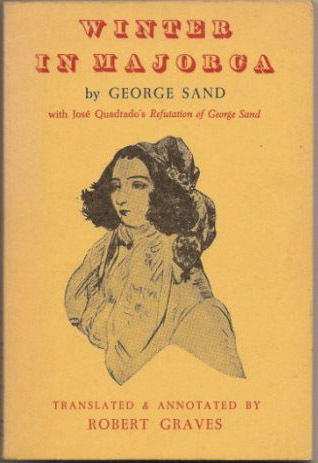
Chopin wrote some of the preludes whilst staying at Valldemossa, Mallorca, during the winter of 1838–39, where he had fled with George Sand and her children to escape the damp Paris weather.
Here are two quite different videos from Youtube about Chopin and Sands stay in Valldemossa!
Chopin, Field and the Nocturne
The term “Nocturne” was first applied to musical pieces in the 18th century. It indicated an ensemble piece in several movements, normally played for an evening party and then laid aside. However, in its more familiar form, as a short piece usually written for solo piano, the nocturne was cultivated primarily in the 19th century.
The first nocturnes to be written for piano were by the Irish composer, John Field (26 July 1782–23 January 1837). Field is generally viewed as the father of the romantic nocturne, being the person who elevated the nocturne to the status later achieved by the great romantic composers, such as Chopin. The nocturne is traditionally associated with the night – a sort of evening serenade. However, it came to be associated more with its musical form. Simply put, it is usually in the form of a pure melody on the right hand with arpeggios on left hand.
Field composed eighteen nocturnes, their mixture of reverie and charming melodic invention providing constant musical delight.
I think one of the best examples of a nocturne in its pure form is Field’s first ever nocturne, Nocturne No. 1 in E Flat Major. I decided, for better or for worse, to record it a few years back. I do hope you enjoy my rendition of it, warts n’all.
Field’s first ever nocturne, Nocturne No. 1 in E FlatMajor
Incidentally, to give some idea of Field’s popularity in Russia – where he lived and worked for many years – he is mentioned in passing in War and Peace. There is a scene in Tolstoy’s novel where Countess Rostova calls on the Rostov household musician to play her favourite nocturne.
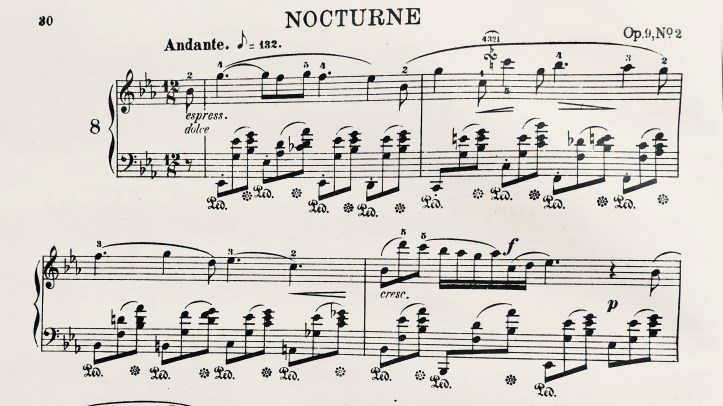
Chopin’s Nocturne in E flat major, Op. 9, No. 2
However, the most famous exponent of the form was Frederick Chopin who wrote 21 nocturnes. His nocturnes for piano solo are undoubtedly among the most glorious in the classical piano repertoire. They cover a broad spectrum of feelings and moods and are rich in musicality.
I am working on two of Chopin’s nocturnes at the moment but I haven’t recorded them yet. Maybe in a future blog when I reach my 300th birthday!
It is one of the curses of being largely self-taught that I fear I have arrived at Chopin a little too late in my life. However, the magic of audio and video recording brings with it immediate access to the genius of Chopin through the beautiful performances of world-renowned pianists.
I recently saw on YouTube a wonderful performance by a young pianist called Tiffany Poon. She is playing Chopin’s Nocturne in E Flat Major, Opus 9, No.2. I found it rather beautiful and very moving. I hope you enjoy it too.
I hope this little blog and Tiffany’s gorgeous playing might entice you, even if you are not normally into classical piano music, to search out more of Chopin’s beautiful nocturnes. I guarantee you will not be disappointed!
Chopin’s Legacy
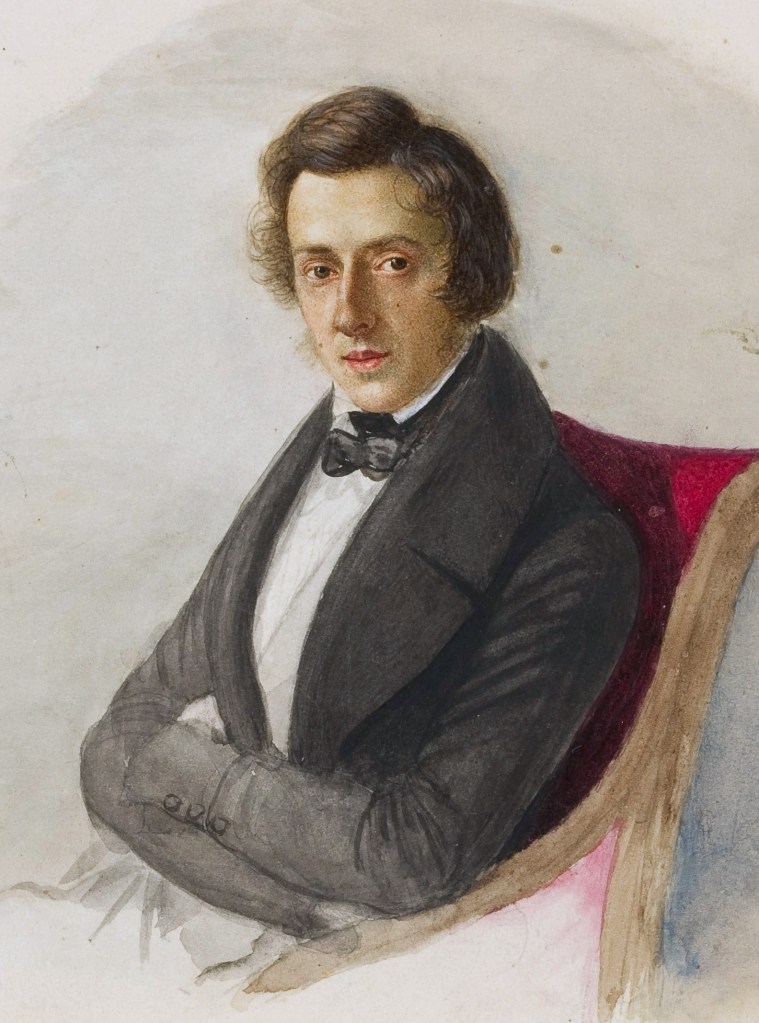
Chopin at 25, by Maria Wodzinska, 1835
Chopin is, undoubtedly, the pianist’s composer. Although he composed two concertos for piano and orchestra and some ensemble pieces, his best-loved compositions are for piano solo. His larger scale works such as the sonatas, the four scherzi, the four ballades, the Fantaisie in F minor, opus 49 and the Barcarolle in F sharp major, opus 60 have cemented a solid place within the piano repertoire, as have his shorter works: the polonaises, the mazurkas, the waltzes, the Impromptus and the nocturnes.
Chopin invested all these works with deep feeling and emotion. His distinctive style conveys a musicality and beauty unsurpassed and the range of his work demonstrates versatility and virtuosity. In order to illustrate this, I have selected three pieces which demonstrate the melodic and emotional depth of his work. I hope my recordings do some justice to these beautiful works.
Piano: John McGuinness
Chopin’s music is still very popular today and has been an inspiration to later pianists, composers and audiences. Indeed, contemporary piano composers are very much influenced by his romantic style and many refer to themselves as the new romantics. Major outlets for this music are to be found in film, theatre and the concert hall. These composers include Ludovico Einaudi, Dario Marianelli, Yiruma and many more.
 John McGuinness Piano